Accommodate vs Accomodate: Which Spelling Is Correct?
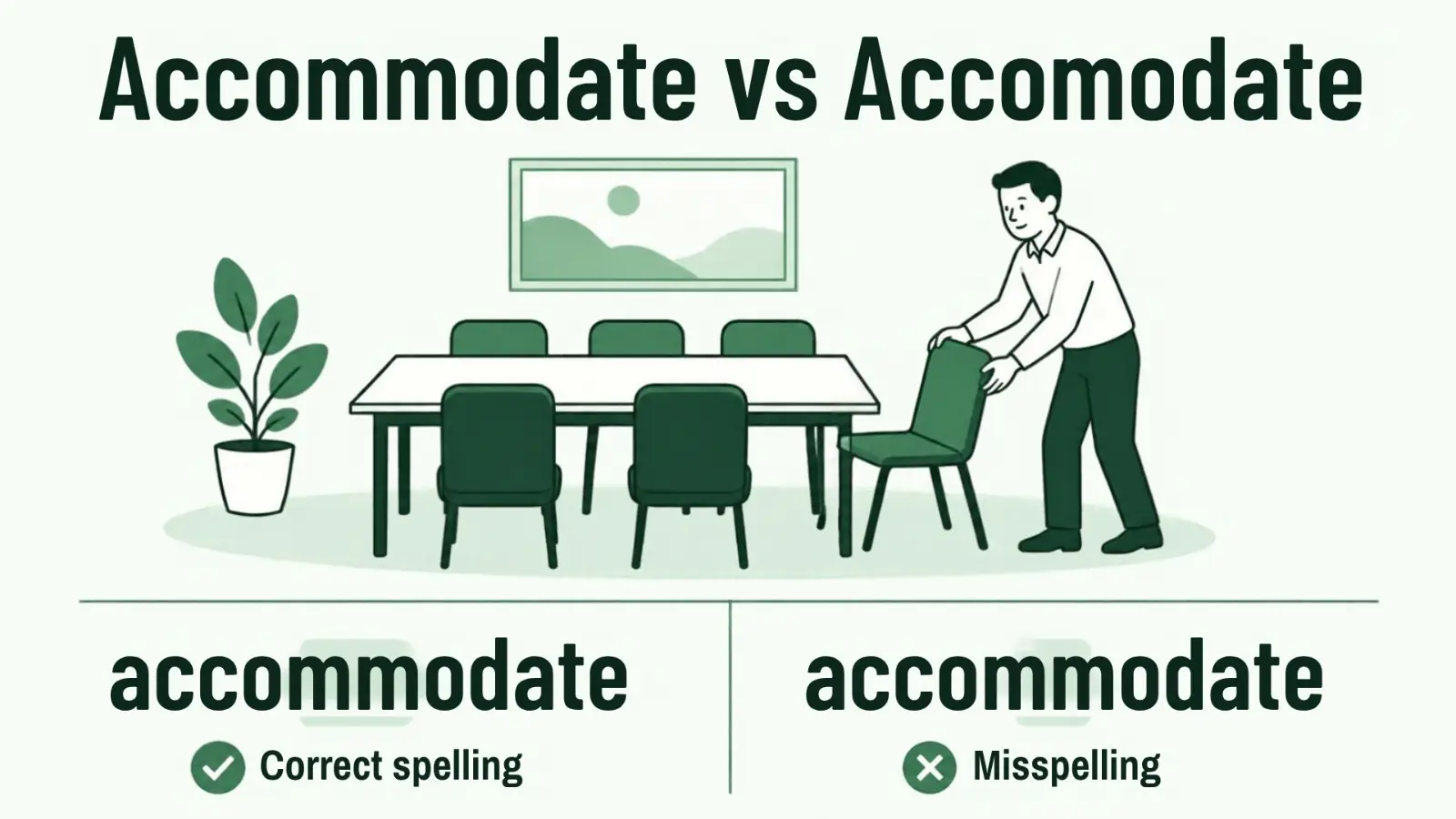
Accommodate is the correct spelling in standard American and British English. Accomodate is a misspelling because it contains only one M instead of two. The correct word has two Cs and two Ms. Whether you’re writing about providing space, meeting someone’s needs, or adjusting plans, always spell the verb accommodate.
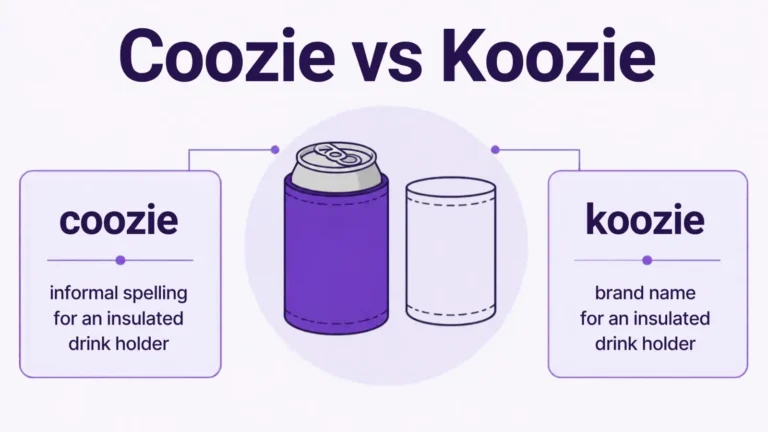
Related Post: Coozie Vs Koozie
Accommodate vs Accomodate: Quick Comparison
| Feature | ✅ Accommodate | ❌ Accomodate |
|---|---|---|
| Spelling | Correct | Incorrect |
| Number of Cs | Two | Two |
| Number of Ms | Two | One |
| Part of speech | Verb | Misspelling |
| Meaning | Provide space, meet needs, or make adjustments | No separate standard meaning |
| Example | Accommodate guests | Accomodate guests |
Example:
❌ Incorrect: The hotel can accomodate 150 guests.
✅ Correct: The hotel can accommodate 150 guests.
Why? The verb accommodate requires two consecutive Cs and two consecutive Ms. Leaving out either letter produces a misspelling.
What Does Accommodate Mean?
Accommodate is a verb with several related meanings. It can mean to provide enough space for someone, meet a person’s needs, or adjust something to suit a particular situation.
Understanding these meanings helps you use the word naturally in everyday and professional writing.
1. Accommodate Means to Provide Enough Space
Use accommodate when a place, building, or facility has enough room for people or things.
Examples:
- The conference room can accommodate 40 participants.
- Our guest room can accommodate two adults.
- The restaurant expanded its seating area to accommodate more customers.
- The new parking lot can accommodate 200 vehicles.
In these sentences, accommodate describes the capacity to hold or provide space for a certain number of people or objects.
📌 Usage Tip: In this meaning, accommodate often appears with numbers or phrases describing capacity.
2. Accommodate Means to Meet Someone’s Needs
Accommodate can also mean making arrangements that help someone with particular needs or circumstances.
Examples:
- The school adjusted its schedule to accommodate students with different learning needs.
- The hotel accommodated the guest’s request for a quieter room.
- The event organizers provided additional seating to accommodate attendees.
- The company changed the meeting time to accommodate employees in different time zones.
Here, accommodate describes responding to a need or request rather than simply providing physical space.
3. Accommodate Means to Adjust or Adapt
The verb can also describe changing a plan, arrangement, or system to make room for new circumstances.
Examples:
- We revised the project timeline to accommodate unexpected delays.
- The software was updated to accommodate additional users.
- The team adjusted its strategy to accommodate changing customer requirements.
- The schedule includes extra time to accommodate last-minute changes.
In these examples, accommodate means making adjustments so that something can work under different conditions.
Why Does Accommodate Have Two Cs and Two Ms?
The most important spelling feature is the pair of double consonants:
AC + COM + MODATE
The complete word is:
ACCOMMODATE
Two Cs + Two Ms = Accommodate
A common mistake is remembering the double C but forgetting the double M.
Compare:
- ✅ Accommodate — Two Cs and two Ms.
- ❌ Accomodate — Two Cs but only one M.
- ❌ Acommodate — One C but two Ms.
- ❌ Acomodate — One C and one M.
An Easy Memory Trick
Think of accommodate as a word that makes room for extra letters.
💡 Memory Tip: “Accommodate has room for two Cs and two Ms.”
This is a spelling reminder rather than a grammatical rule. It helps you remember the exact letter pattern whenever you write the word.
Accommodate, Accommodated, and Accommodating
The correct spelling keeps both double-letter pairs across the word family. The endings change depending on the grammatical role.
| Word | Grammar | Example |
|---|---|---|
| Accommodate | Base verb | We can accommodate your request. |
| Accommodates | Present tense | This room accommodates 30 people. |
| Accommodated | Past tense or past participle | The hotel accommodated our group. |
| Accommodating | -ing form or adjective | The staff were accommodating. |
| Accommodation | Related noun | We arranged accommodation for the visitors. |
The standard verb forms are also recorded in dictionary entries.
Why Does Accommodate Become Accommodating?
When adding -ing, remove the final E:
✅ Accommodate → Accommodating
❌ Accommodateing
When forming the past tense, add D because accommodate already ends in E:
✅ Accommodate → Accommodated
❌ Accommodateed
The spelling pattern stays consistent: CC and MM remain together.
Common Spelling Mistakes With Accommodate
Mistake 1: Leaving Out One M
❌ Incorrect: Can you accomodate our meeting request?
✅ Correct: Can you accommodate our meeting request?
Explanation: Accommodate contains two Ms, not one.
Mistake 2: Leaving Out One C
❌ Incorrect: The hotel can acommodate our entire group.
✅ Correct: The hotel can accommodate our entire group.
Explanation: The word begins with ACC, not AC.
Mistake 3: Misspelling the Past Tense
❌ Incorrect: The restaurant accomodated our dietary requests.
✅ Correct: The restaurant accommodated our dietary requests.
Explanation: Accommodated retains both double consonants.
Mistake 4: Misspelling the Related Noun
❌ Incorrect: We need to arrange accomodation for the guests.
✅ Correct: We need to arrange accommodation for the guests.
Explanation: Accommodation follows the same CC and MM spelling pattern.
How to Use Accommodate in a Professional Email
The verb accommodate is useful when discussing schedules, requests, and arrangements.
Example email:
Hello Jordan,
We can accommodate your request to move the meeting to Thursday afternoon. The updated schedule gives everyone enough time to review the documents.
Please let us know if you need any additional adjustments.
Best regards, Taylor
Why does accommodate work here?
The sentence describes making an adjustment to meet someone’s scheduling needs. Accommodate is appropriate because it means adapting an arrangement to suit a request.
The word does not imply that every request must be accepted. For example, “We cannot accommodate that request” is also grammatically correct.
Quick Practice: Accommodate or Accomodate?
Choose the correct spelling in each sentence.
Question 1: The conference hall can _____ 300 guests.
A. Accomodate B. Accommodate
Question 2: The manager _____ our request for a later appointment.
A. Accommodated B. Accomodated
Question 3: The staff were very _____ during our visit.
A. Accomodating B. Accommodating
Answers and Explanations
| Question | Correct answer | Explanation |
|---|---|---|
| 1 | ✅ B. Accommodate | The correct verb has two Cs and two Ms. |
| 2 | ✅ A. Accommodated | The past tense retains both double consonants. |
| 3 | ✅ B. Accommodating | The -ing form keeps CC and MM and drops the final E. |
Accomodate is a misspelling of the standard English verb accommodate. It omits one M. Use accommodate in contemporary American and British English. Accomodate is specifically identified as a common misspelling.
Yes. The correct spelling is A-C-C-O-M-M-O-D-A-T-E. It contains two consecutive Cs and two consecutive Ms.
No. Both American and British English use accommodate. The same spelling is recorded for both varieties.
Accommodate is a verb meaning to provide space, meet a need, or make an adjustment. Accommodation is a related noun. It can refer to an arrangement made to meet a need or to lodging, among other meanings. Examples: The hotel can accommodate 50 guests. The hotel provides accommodations for 50 guests. Both forms retain the double C and double M.
Sources
- Cambridge Dictionary — Accommodate — Definitions, usage, and American and British spelling.
- Cambridge Dictionary — Accommodating — Related adjective and its meaning.

Emily Carter is the writer behind ChuckleStation.com, a site that untangles grammar mistakes, tricky word choices, and common spelling slipups. She focuses on the errors people actually make in emails, essays, captions, and texts, then explains why they happen in plain English.
Every article pairs a clear rule with real sentences, so readers can spot the mistake and fix it fast. Emily double checks each explanation against trusted dictionaries and style guides, because getting a grammar answer wrong defeats the whole point.
She believes good writing shouldn’t feel intimidating. A little humor, a few memorable examples, and a straight answer usually do more than a page of rules.