Coming vs Comming: Which Spelling Is Correct?
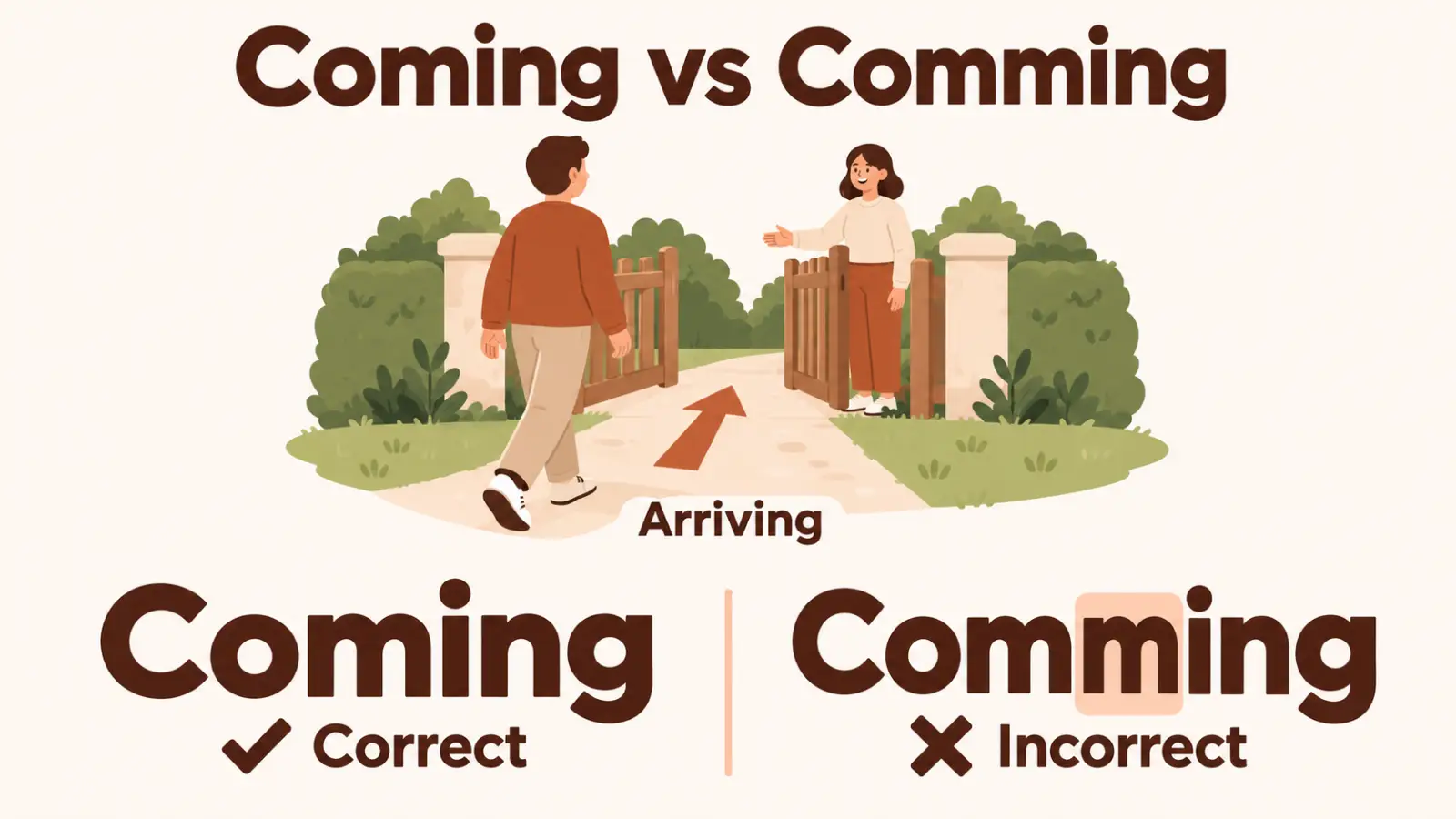
Coming is the correct spelling in standard American and British English. Comming is a misspelling because it incorrectly doubles the letter M. The word coming is formed by removing the final E from come before adding -ing. Whether you’re describing someone arriving, an approaching event, or something happening soon, use coming with one M.
Coming vs Comming: Quick Comparison
| Feature | Coming | Comming |
|---|---|---|
| Spelling | ✅ Correct | ❌ Incorrect |
| Number of Ms | One | Two |
| Base verb | Come | Not a standard form of come |
| Word formation | Come − E + ING | Incorrect doubling of M |
| Example | I’m coming home. | I’m comming home. |
| US and UK English | Standard | Misspelling |
Example:
❌ Incorrect: My friends are comming over tonight.
✅ Correct: My friends are coming over tonight.
Why? The base verb is come. To form coming, remove the final E and add ING without doubling the M.
Why Is Coming Spelled With One M?
The spelling follows a common English rule for verbs ending in a silent E.
When adding -ing to many verbs ending in a silent E, remove the final E before adding the ending.
Word formation:
COME COMING
Drop the final E, then add ING. Keep one M.
The same spelling pattern appears in other everyday verbs:
- Come → Coming
- Make → Making
- Take → Taking
- Write → Writing
- Dance → Dancing
In each example, the final E disappears before ING is added.
Important: This is a common spelling pattern, not a rule that applies to every verb ending in E. For example, see → seeing keeps both Es.
An Easy Way to Remember Coming
Think of the sentence:
“Come with me. I’m coming.”
The verb come has one M, and its -ing form keeps that same single M.
💡 Memory Tip: Come loses E, not its spelling pattern. Remove E and add ING. Don’t add another M.
What Does Coming Mean?
Coming is the present participle of the verb come. It can also function as an adjective in certain expressions.
The meaning depends on the sentence.
1. Coming Means Moving Toward a Place
Use coming when someone or something is moving toward a particular location or reference point.
Examples:
- I’m coming home after work.
- Sarah is coming to the party tonight.
- The delivery driver is coming down the street.
- Are you coming with us?
In these sentences, coming describes movement or arrival.
2. Coming Can Refer to Future Events
Coming can also describe something expected to happen or arrive soon.
Examples:
- The coming weeks will be busy.
- We have several meetings coming up.
- A storm is coming this evening.
- The company is preparing for the coming holiday season.
Here, coming refers to an approaching event or period rather than a person physically moving.
3. Coming Can Describe an Upcoming Stage
In some expressions, coming functions as an adjective that describes something expected in the future.
Examples:
- The coming semester will introduce new courses.
- We expect major improvements in the coming months.
- The coming election will determine the committee’s leadership.
In these examples, coming modifies nouns such as semester, months, and election.
Common Mistakes With Coming
Mistake 1: Doubling the M
❌ Incorrect: I’m comming to the meeting.
✅ Correct: I’m coming to the meeting.
Explanation: Coming contains one M. Remove the final E from come and add ING.
Mistake 2: Keeping the Final E
❌ Incorrect: My sister is comeing home tomorrow.
✅ Correct: My sister is coming home tomorrow.
Explanation: The final E is dropped before adding ING.
Mistake 3: Confusing Coming With Came
❌ Incorrect: She coming to the office yesterday.
✅ Correct: She came to the office yesterday.
Explanation: Came is the simple past tense of come. Coming is the -ing form and generally needs an auxiliary verb such as is, was, or will be when used in a continuous tense.
Compare:
- Present continuous: She is coming to the office.
- Past simple: She came to the office yesterday.
- Past continuous: She was coming to the office when her car broke down.
It is confirmed that come has the past-tense form came and the past participle come.
Come, Came, Come, and Coming
The verb come is irregular in its past-tense forms, even though forming coming follows a common spelling pattern.
| Form | Grammatical use | Example |
|---|---|---|
| Come | Base verb | Please come inside. |
| Comes | Present, third-person singular | He comes here every Friday. |
| Came | Simple past | They came yesterday. |
| Come | Past participle | She has come home. |
| Coming | -ing form | They’re coming soon. |
Notice that came, not comed, is the past tense. The past participle is come, not came.
Quick Practice: Coming or Comming?
Choose the correct form in each sentence.
1. My parents are _____ over for dinner.
A. Comming B. Coming
2. The school festival is _____ up next month.
A. Coming B. Comming
3. He was _____ home when the rain started.
A. Comming B. Coming
Answers and Explanations
- B. Coming — The correct -ing form of come contains one M.
- A. Coming — Coming up means approaching or happening soon.
- B. Coming — The past continuous uses was + coming.
Comming is not the standard spelling of the -ing form of come. Use coming in contemporary American and British English. A proper name may have a different spelling, but that does not change the verb’s standard form.
The correct spelling is coming. Both comming and comeing are incorrect forms of the verb come.
The verbs follow different spelling patterns. Run → Running: The final N doubles before ING. Come → Coming: The final silent E is removed, and the M does not double. The consonant-doubling pattern that applies to run does not apply to come.
Coming soon is correct. For example: The new restaurant is coming soon. Our next video is coming soon. A product update is coming soon.
Sources
- Cambridge Dictionary — Come — Definitions, verb forms, and examples of coming.

Emily Carter is the writer behind ChuckleStation.com, a site that untangles grammar mistakes, tricky word choices, and common spelling slipups. She focuses on the errors people actually make in emails, essays, captions, and texts, then explains why they happen in plain English.
Every article pairs a clear rule with real sentences, so readers can spot the mistake and fix it fast. Emily double checks each explanation against trusted dictionaries and style guides, because getting a grammar answer wrong defeats the whole point.
She believes good writing shouldn’t feel intimidating. A little humor, a few memorable examples, and a straight answer usually do more than a page of rules.