Babies vs Babys: Which Spelling Is Correct?
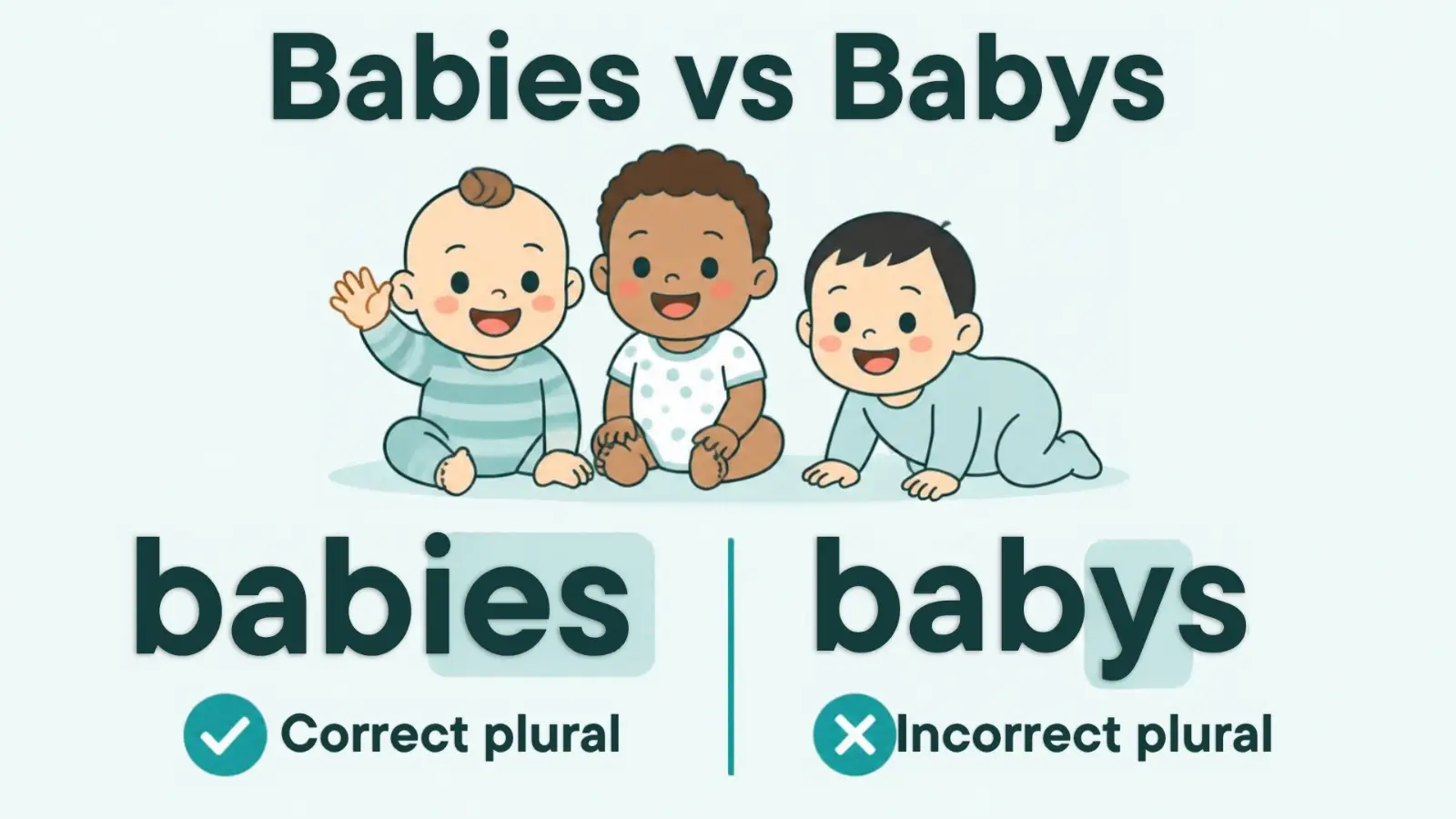
Babies is the correct plural spelling of baby in standard English. Babys is incorrect when referring to more than one baby. Because baby ends in a consonant followed by Y, you change the Y to I and add ES. However, if you want to show that something belongs to a baby, use baby’s or babies’, depending on the number of babies.
Babies vs Babys: Quick Comparison
| Form | Correct? | Meaning | Example |
|---|---|---|---|
| Baby | ✅ Yes | One baby | The baby is sleeping. |
| Babies | ✅ Yes | Two or more babies | The babies are sleeping. |
| Babys | ❌ No | Incorrect plural | The babys are sleeping. |
| Baby’s | ✅ Yes | Belonging to one baby | The baby’s blanket is soft. |
| Babies’ | ✅ Yes | Belonging to multiple babies | The babies’ blankets are clean. |
Example:
❌ Incorrect: Three babys were playing in the nursery.
✅ Correct: Three babies were playing in the nursery.
Why? Baby ends in a consonant followed by Y. To form the plural, replace Y with I and add ES.
Why Is the Plural of Baby Babies?
The plural of baby follows a common English spelling rule for nouns ending in a consonant followed by Y.
A consonant is a letter such as B, C, D, or T. In baby, the letter B comes immediately before the final Y.
For this type of noun, the plural is usually formed by changing Y to I and adding ES.
Word formation:
Baby
Babies
Replace the final Y with IES.
The same pattern appears in several everyday nouns:
- Baby → Babies
- City → Cities
- Puppy → Puppies
- Story → Stories
- Family → Families
💡 Memory Tip: When baby becomes plural, the final Y changes to IES. Think one baby, two babies.
This rule applies to many nouns ending in a consonant + Y, but not to every word ending in Y.
When Do You Keep the Y and Add S?
If a noun ends in a vowel followed by Y, you usually keep the Y and add S.
Vowels include A, E, I, O, and U.
Examples:
- Toy → Toys
- Boy → Boys
- Day → Days
- Key → Keys
- Monkey → Monkeys
Compare these two words:
Baby: The letter before Y is B, a consonant.
✅ Baby → Babies
Boy: The letter before Y is O, a vowel.
✅ Boy → Boys
📌 Important: Check the letter immediately before the final Y. That tells you which of these common plural patterns to use.
There are exceptions in English, especially with some proper names and borrowed words, so this is a practical rule for common nouns rather than a universal rule for every word ending in Y.
Babies vs Baby’s vs Babies’: What’s the Difference?
This is where spelling and grammar work together. Although the words look similar, babies, baby’s, and babies’ perform different jobs.
1. Babies: More Than One Baby
Use babies when you are talking about two or more babies without showing possession.
Examples:
- The babies are sleeping peacefully.
- Four babies attended the family gathering.
- Both babies smiled when their father entered the room.
- The nursery has enough cribs for six babies.
In each sentence, babies is a plural noun.
2. Baby’s: Something Belonging to One Baby
Use baby’s when something belongs to one baby.
The apostrophe comes before S because the noun is singular.
Examples:
- The baby’s bottle is on the kitchen counter.
- Her baby’s first tooth appeared last week.
- The baby’s blanket needs washing.
- We decorated the baby’s room with colorful pictures.
Sentence diagnosis:
“The baby’s blanket is blue.”
Here, baby’s tells us that the blanket belongs to one baby. It does not mean several babies.
The form baby’s can also be a contraction of baby is or baby has, depending on the sentence.
For example:
- The baby’s asleep. = The baby is asleep.
- The baby’s been crying. = The baby has been crying.
3. Babies’: Something Belonging to Multiple Babies
Use babies’ when something belongs to two or more babies.
Because babies already ends in S, the possessive apostrophe goes after that S.
Examples:
- The babies’ toys were scattered across the floor.
- The nurse checked the babies’ temperatures.
- The babies’ blankets were folded neatly.
- Both babies’ parents attended the meeting.
Sentence diagnosis:
“The babies’ blankets are clean.”
The phrase babies’ blankets means blankets belonging to multiple babies.
The apostrophe placement changes the meaning:
- Baby’s toys: Toys belonging to one baby.
- Babies’ toys: Toys belonging to multiple babies.
Common Mistakes With Babies and Babys
Mistake 1: Adding S Without Changing Y
❌ Incorrect: The babys are playing in the living room.
✅ Correct: The babies are playing in the living room.
Explanation: Baby ends in a consonant followed by Y. Its plural is babies, not babys.
Mistake 2: Using an Apostrophe for a Simple Plural
❌ Incorrect: The baby’s are sleeping.
✅ Correct: The babies are sleeping.
Explanation: The sentence refers to multiple babies. It does not show possession, so no apostrophe is needed.
Mistake 3: Confusing Singular and Plural Possession
❌ Incorrect for multiple babies: The baby’s bottles were labeled with their names.
✅ Correct: The babies’ bottles were labeled with their names.
Explanation: If the bottles belong to multiple babies, the apostrophe belongs after the S in babies.
The first sentence could be correct if the bottles belonged to just one baby. The context determines which possessive form you need.
Practice: Babies, Baby’s, or Babies’?
Choose the correct form for each sentence.
Question 1: Three _____ were sleeping in their cribs.
A. Babys B. Babies C. Baby’s
Question 2: The _____ favorite toy is a stuffed elephant. (One baby)
A. Baby’s B. Babies’ C. Babies
Question 3: The nurse checked the _____ temperatures. (Several babies)
A. Baby’s B. Babies’ C. Babys
Question 4: Both _____ smiled at the photographer.
A. Babies B. Baby’s C. Babys
Answers and Explanations
| Question | Correct answer | Explanation |
|---|---|---|
| 1 | ✅ B. Babies | Three means more than one baby. |
| 2 | ✅ A. Baby’s | The toy belongs to one baby. |
| 3 | ✅ B. Babies’ | The temperatures belong to several babies. |
| 4 | ✅ A. Babies | Both requires the plural noun. |
Babys is not the standard plural spelling of baby. Use babies when referring to more than one baby. The spelling babys could appear in a proper name or as a typographical error, but it should not replace babies in ordinary English sentences.
Use babies when referring to the twins themselves. ✅ The babies are sleeping. Use baby’s when referring to something belonging to only one baby. ✅ The baby’s blanket is blue.
Yes. Babies is the standard plural of baby in both American and British English. The same basic plural spelling rule applies in both varieties.
Yes. Babies can also be the third-person singular present-tense form of the verb baby, meaning to treat someone with excessive care or protection. Example: He babies his younger brother whenever they play together. In that sentence, babies describes an action rather than multiple infants. The spelling is the same, but its grammatical role is different.
Sources
- Cambridge Dictionary — Nouns: Form — Explains the consonant + Y plural pattern and specifically gives baby → babies.
Emily Carter is the writer behind ChuckleStation.com, a site that untangles grammar mistakes, tricky word choices, and common spelling slipups. She focuses on the errors people actually make in emails, essays, captions, and texts, then explains why they happen in plain English.
Every article pairs a clear rule with real sentences, so readers can spot the mistake and fix it fast. Emily double checks each explanation against trusted dictionaries and style guides, because getting a grammar answer wrong defeats the whole point.
She believes good writing shouldn’t feel intimidating. A little humor, a few memorable examples, and a straight answer usually do more than a page of rules.