Acquire vs Aquire: Which Spelling Is Correct?
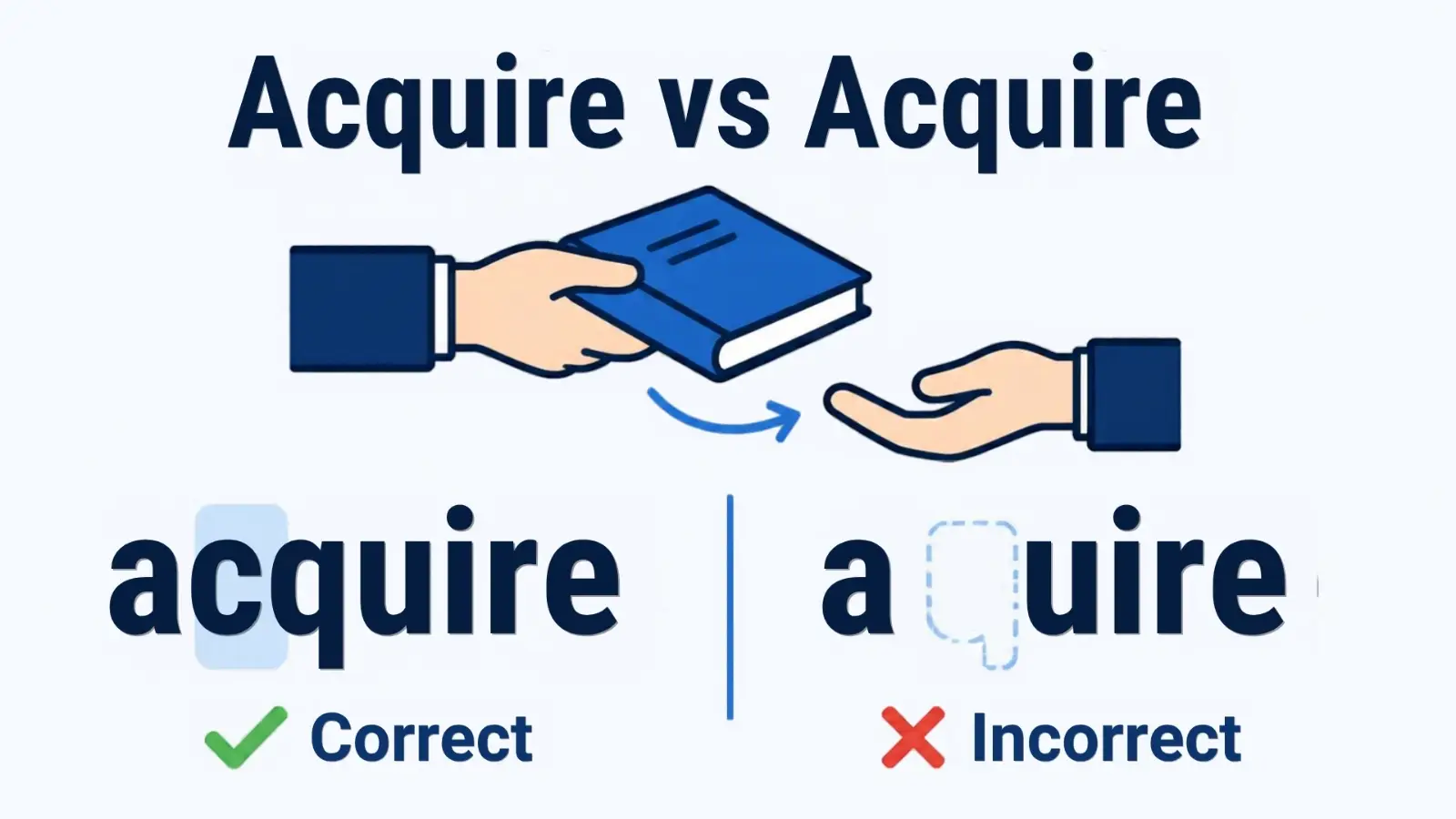
Acquire is the correct spelling in American and British English. Aquire is a misspelling when you mean to obtain something, gain knowledge, develop a skill, or take ownership of property. The easiest way to remember the correct spelling is that acquire begins with ACQ, while aquire is missing the letter C.
Acquire vs Aquire: Quick Comparison
| Feature | ✅ Acquire | ❌ Aquire |
|---|---|---|
| Spelling | Correct | Incorrect |
| Meaning | To obtain, gain, or develop | No separate standard verb meaning |
| Part of speech | Verb | Not a standard verb |
| American English | Accepted | Misspelling |
| British English | Accepted | Misspelling |
| Example | Acquire new skills | Aquire new skills ❌ |
Example:
❌ Incorrect: She wants to aquire new skills before applying for a job.
✅ Correct: She wants to acquire new skills before applying for a job.
Why? The correct spelling contains the letter C between A and Q. Both sentences express the same intended meaning, but only the second uses standard English spelling.
What Does Acquire Mean?
Acquire is a verb that means to obtain something, gain possession of it, or develop a skill, quality, or understanding.
You can acquire physical objects such as land, equipment, or property. You can also acquire things that cannot be touched, including knowledge, confidence, and experience.
1. Acquire Knowledge or Skills
Use acquire when someone gains knowledge or develops an ability through learning, training, or experience.
Examples:
- Students acquire vocabulary through reading and conversation.
- Maya acquired valuable leadership skills during her internship.
- You can acquire basic coding skills through regular practice.
- New employees acquire workplace knowledge through training.
💡 Remember: When you acquire a skill, you gain or develop that ability. You do not necessarily buy anything.
2. Acquire Property or Possessions
Acquire can describe obtaining something you can own.
Examples:
- The family plans to acquire a larger house.
- The museum acquired a rare painting for its collection.
- He acquired several antique books from his grandfather.
- The organization hopes to acquire land for a new building.
📌 Important: Acquire does not always mean buy. Someone can acquire property through a purchase, gift, or inheritance.
3. Acquire a Company or Business
In business writing, acquire commonly refers to obtaining ownership or control of a company.
Examples:
- The software company plans to acquire a smaller competitor.
- A national retailer acquired three local stores.
- Investors are discussing acquiring a regional business.
- The corporation hopes to acquire another technology company.
The related noun acquisition describes the act or process of acquiring something, including a business.
How to Remember the Correct Spelling of Acquire
The simplest spelling trick is to remember the first three letters:
A + C + Q = ACQ
| ✅ Correct spelling | ❌ Incorrect spelling |
|---|---|
| A C Q U I R E | A Q U I R E |
| Contains C before Q | Missing C |
| Seven letters | Six letters |
Another useful connection is the word acquisition.
Both acquire and acquisition begin with the same three letters: ACQ.
Word-family examples:
- Acquire — ACQ + UIRE
- Acquired — ACQ + UIRED
- Acquiring — ACQ + UIRING
- Acquisition — ACQ + UISITION
💡 Memory Tip: Think of the word acquisition whenever you need to spell acquire. Both words keep the ACQ pattern.
This memory aid applies to this word family. It is not a spelling rule for every English word containing QU.
Acquire, Acquired, Acquiring, and Acquisition
Acquire has several related forms. Understanding them helps you avoid spelling mistakes in different sentences.
| Word | Grammar | Example |
|---|---|---|
| Acquire | Base verb | I want to acquire new skills. |
| Acquires | Present tense, third-person singular | She acquires clients through referrals. |
| Acquired | Past tense or past participle | We acquired new equipment last month. |
| Acquiring | -ing form | He is acquiring practical experience. |
| Acquisition | Related noun | The acquisition expanded the company. |
Why Does Acquire Become Acquiring?
When you add -ing to acquire, the final E is removed.
✅ Acquire → Acquiring
❌ Acquireing
Example:
- ❌ He is acquireing new skills.
- ✅ He is acquiring new skills.
How Do You Form the Past Tense?
Because acquire already ends in E, you add only D to form the past tense.
✅ Acquire → Acquired
❌ Acquireed
Example:
- ❌ She acquireed a new laptop.
- ✅ She acquired a new laptop.
The key spelling pattern stays the same: every form begins with ACQ.
Common Spelling Mistakes With Acquire
Here are three mistakes that can appear in school assignments, emails, and professional writing.
Mistake 1: Leaving Out the Letter C
❌ Incorrect: We need to aquire more customers.
✅ Correct: We need to acquire more customers.
Explanation: Acquire begins with ACQ. Aquire is missing the C.
Mistake 2: Misspelling the Past Tense
❌ Incorrect: She aquired valuable experience during her internship.
✅ Correct: She acquired valuable experience during her internship.
Explanation: Acquired is the correct past-tense form. The C remains in the spelling.
Mistake 3: Misspelling the -ing Form
❌ Incorrect: The company is aquiring new equipment.
✅ Correct: The company is acquiring new equipment.
Explanation: Acquiring keeps the C and drops the final E before -ing.
Acquire vs Get: What’s the Difference?
Both acquire and get can mean to obtain something. However, acquire often sounds more formal and can emphasize gaining possession, knowledge, or an ability.
| Acquire | Get |
|---|---|
| Often more formal | Common in everyday conversation |
| Emphasizes obtaining or developing | Has a wider range of meanings |
| Common in business and academic writing | Common in casual and formal writing |
| Acquire new skills | Get new skills |
| Acquire property | Get property |
| Acquire experience | Get experience |
Example 1: Everyday English
“I want to get more experience before changing jobs.”
Example 2: More Formal English
“I want to acquire more experience before changing jobs.”
Both sentences are grammatically correct.
📌 Important: Acquire cannot replace get in every sentence.
For example:
✅ I get what you’re saying.
❌ I acquire what you’re saying.
In this context, get means understand. Acquire does not normally express that meaning.
Writing Tip: Choose acquire when you mean to obtain, gain, or develop something. Use get when it better fits the meaning and tone of your sentence.
Practice: Choose Acquire or Aquire
Test your understanding with these four sentences.
Question 1: She wants to _____ more confidence before her presentation.
A. Acquire
B. Aquire
Question 2: The business _____ a new office last year.
A. Aquired
B. Acquired
Question 3: He is _____ new skills through training.
A. Aquiring
B. Acquiring
Question 4: The company’s latest _____ was announced yesterday.
A. Acquisition
B. Aquisition
Answers and Explanations
| Question | Correct Answer | Explanation |
|---|---|---|
| 1 | ✅ Acquire | The standard spelling contains ACQ. |
| 2 | ✅ Acquired | The past tense retains the C. |
| 3 | ✅ Acquiring | Keep ACQ and remove the final E. |
| 4 | ✅ Acquisition | The related noun also begins with ACQ. |
Quick Reminder: Acquire, acquired, acquiring, and acquisition all begin with the letters ACQ.
Aquire is not an accepted standard spelling of the English verb acquire. It may appear as a proper name or brand, but when you mean to obtain or gain something, the correct spelling is acquire.
No. Acquire is the standard spelling in both American and British English. Unlike color and colour, acquire does not have a standard regional spelling variation.
The past tense of acquire is acquired.Example: The company acquired new equipment last month.Acquired is also the past participle.Example: She has acquired several useful skills.
Yes. Acquire means to obtain or gain something, which does not always involve payment.For example, you can acquire knowledge through study, property through inheritance, or an ability through practice.
Sources

Emily Carter is the writer behind ChuckleStation.com, a site that untangles grammar mistakes, tricky word choices, and common spelling slipups. She focuses on the errors people actually make in emails, essays, captions, and texts, then explains why they happen in plain English.
Every article pairs a clear rule with real sentences, so readers can spot the mistake and fix it fast. Emily double checks each explanation against trusted dictionaries and style guides, because getting a grammar answer wrong defeats the whole point.
She believes good writing shouldn’t feel intimidating. A little humor, a few memorable examples, and a straight answer usually do more than a page of rules.