
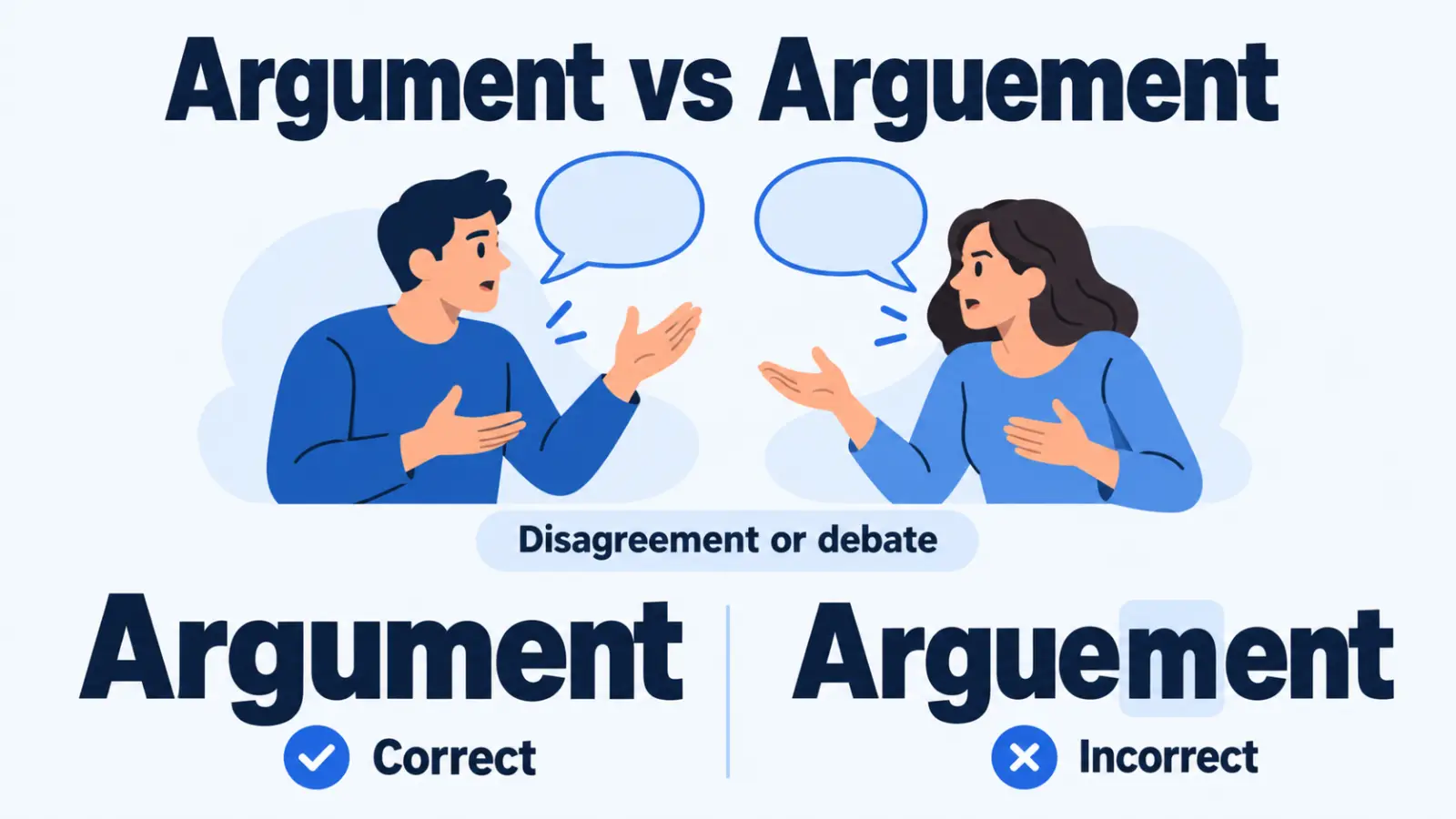
Argument vs Arguement: Which Spelling Is Correct?
Argument is the correct spelling in standard American and British English. Arguement is a misspelling when referring to a disagreement, debate, or reason used to support a claim. Although the verb argue ends in E, that letter disappears when forming the noun argument. Remember: argue + ment = argument, not arguement.
Argument vs Arguement: Quick Comparison
| Feature | ✅ Argument | ❌ Arguement |
|---|---|---|
| Spelling | Correct | Incorrect |
| Part of speech | Noun | Misspelling of a noun |
| Meaning | Disagreement or supporting reason | No separate standard meaning |
| American English | Standard | Misspelling |
| British English | Standard | Misspelling |
| Example | A strong argument | A strong arguement ❌ |
Example:
❌ Incorrect: We had an arguement about the project deadline.
✅ Correct: We had an argument about the project deadline.
Why? The noun argument drops the final E from argue before adding the suffix -ment.
What Does Argument Mean?
Argument is a noun with two important everyday meanings. It can describe a disagreement between people or a set of reasons supporting a particular position.
Understanding these meanings helps you choose the word correctly in conversations, essays, and professional writing.
1. Argument Means a Disagreement
An argument can be a situation in which two or more people express opposing opinions, sometimes angrily.
Examples:
- Sarah had an argument with her brother about borrowing the car.
- The neighbors got into an argument over parking spaces.
- Their argument started when they disagreed about the budget.
- We settled the argument before the meeting ended.
In these sentences, argument describes a disagreement rather than a carefully developed explanation.
📌 Usage Tip: An argument does not have to involve shouting. People can disagree calmly and still have an argument.
2. Argument Means a Reasoned Position
In academic, professional, and persuasive writing, an argument is a claim supported by reasons or evidence.
Examples:
- The student presented a convincing argument for extending library hours.
- Her argument included research findings and practical examples.
- The lawyer developed an argument based on the available evidence.
- His argument explained why the proposed policy needed revision.
Here, argument does not necessarily mean a quarrel. It refers to reasoning intended to support a conclusion.
Compare these sentences:
- Disagreement: They had an argument about the new schedule.
- Reasoning: She made an argument for changing the schedule.
The first sentence describes a disagreement. The second describes a position supported by reasons.
Why Is Argument Spelled Without an E?
The spelling mistake usually happens because the related verb argue ends with E.
When the noun argument is formed, that final E is dropped before adding -ment.
| Word Formation | Result |
|---|---|
| Argue | Base verb |
| Argu + ment | Correct formation |
| Argument | ✅ Correct noun |
| Arguement | ❌ Incorrect spelling |
Correct word formation:
✅ Argue → Argument
❌ Argue → Arguement
This is a useful pattern to remember for argument, but it is not a universal rule for every verb ending in E.
For example, agree → agreement keeps the E. Similarly, manage → management retains it.
💡 Memory Tip: Remember the short sequence ARGU + MENT. If you see an E between U and M in argument, remove it.
Argue vs Argument: What’s the Difference?
Argue and argument belong to the same word family, but they perform different grammatical jobs.
- Argue is a verb. It describes the action of disagreeing or presenting reasons.
- Argument is a noun. It names the disagreement or the reasoning itself.
| Word | Grammar | Example |
|---|---|---|
| Argue | Verb | They argue about household chores. |
| Argues | Present-tense verb | She argues for better public transportation. |
| Argued | Past-tense verb | The students argued about the results. |
| Arguing | -ing verb form | They are arguing about the rules. |
| Argument | Noun | Their argument lasted ten minutes. |
| Arguments | Plural noun | Both sides presented strong arguments. |
How to Choose Between Argue and Argument
Look at the job the word performs in your sentence.
Example 1: Describing an action
✅ They argue about money.
Here, argue tells us what the people do.
Example 2: Naming a disagreement
✅ They had an argument about money.
Here, argument names the disagreement.
Example 3: Describing a reasoned position
✅ She presented an argument for changing the policy.
Here, argument names the reasoning used to support her position.
The distinction is grammatical: argue is a verb, while argument is a noun.
Common Spelling Mistakes With Argument
These examples show how the misspelling can appear in everyday writing.
Mistake 1: Using Arguement in a Personal Message
❌ Incorrect: I don’t want another arguement about our weekend plans.
✅ Correct: I don’t want another argument about our weekend plans.
Explanation: Argument is the correct noun for a disagreement. The final E from argue is not retained.
Mistake 2: Misspelling Argument in an Essay
❌ Incorrect: The writer supports her arguement with historical evidence.
✅ Correct: The writer supports her argument with historical evidence.
Explanation: In academic writing, argument can mean a position supported by reasons or evidence. The spelling remains argument.
Mistake 3: Misspelling the Plural Form
❌ Incorrect: Both teams presented convincing arguements.
✅ Correct: Both teams presented convincing arguments.
Explanation: The plural is formed by adding S to argument. There is no E before -ment in either the singular or plural form.
Mistake 4: Using the Wrong Form in a Work Email
❌ Incorrect: The manager made a strong arguement for hiring another employee.
✅ Correct: The manager made a strong argument for hiring another employee.
Explanation: The sentence refers to a reasoned position. Argument is the correct spelling and grammatical form.
Practice: Argument or Arguement?
Choose the correct spelling in each sentence before checking the answers.
Question 1: The students had an _____ about the school rules.
A. Argument B. Arguement
Question 2: Her _____ included three convincing examples.
A. Arguement B. Argument
Question 3: Both lawyers presented their _____ in court.
A. Arguments B. Arguements
Answers and Explanations
| Question | Correct answer | Explanation |
|---|---|---|
| 1 | ✅ Argument | Names a disagreement and omits the E. |
| 2 | ✅ Argument | Names a reasoned position. |
| 3 | ✅ Arguments | The plural adds S to argument. |
💡 Quick Reminder: The noun argument is spelled A-R-G-U-M-E-N-T. It contains only one E, near the end of the word.
Arguement is not the standard spelling of the English noun argument. In ordinary writing, use argument whether you mean a disagreement or a reasoned position. An original misspelling may be preserved when quoting someone else’s exact words, but that does not make it standard spelling.
Argument is formed from the verb argue, but its established spelling omits the final E before -ment. The spelling is argu + ment = argument. Not every verb ending in E follows this pattern. Agreement, for example, retains the E from agree.
Argument is the standard spelling in both British and American English. There is no standard regional spelling distinction between these two forms.
The plural is arguments. Simply add S to the singular noun. Example: The committee considered several arguments before making its decision. The plural has the same spelling whether it refers to disagreements or reasons supporting a position.
Sources
- Cambridge Dictionary — Argument: Standard spelling and meanings involving disagreements and supporting reasons.

Emily Carter is the writer behind ChuckleStation.com, a site that untangles grammar mistakes, tricky word choices, and common spelling slipups. She focuses on the errors people actually make in emails, essays, captions, and texts, then explains why they happen in plain English.
Every article pairs a clear rule with real sentences, so readers can spot the mistake and fix it fast. Emily double checks each explanation against trusted dictionaries and style guides, because getting a grammar answer wrong defeats the whole point.
She believes good writing shouldn’t feel intimidating. A little humor, a few memorable examples, and a straight answer usually do more than a page of rules.


One Comment