Aerofoil vs Airfoil: What’s the Difference?
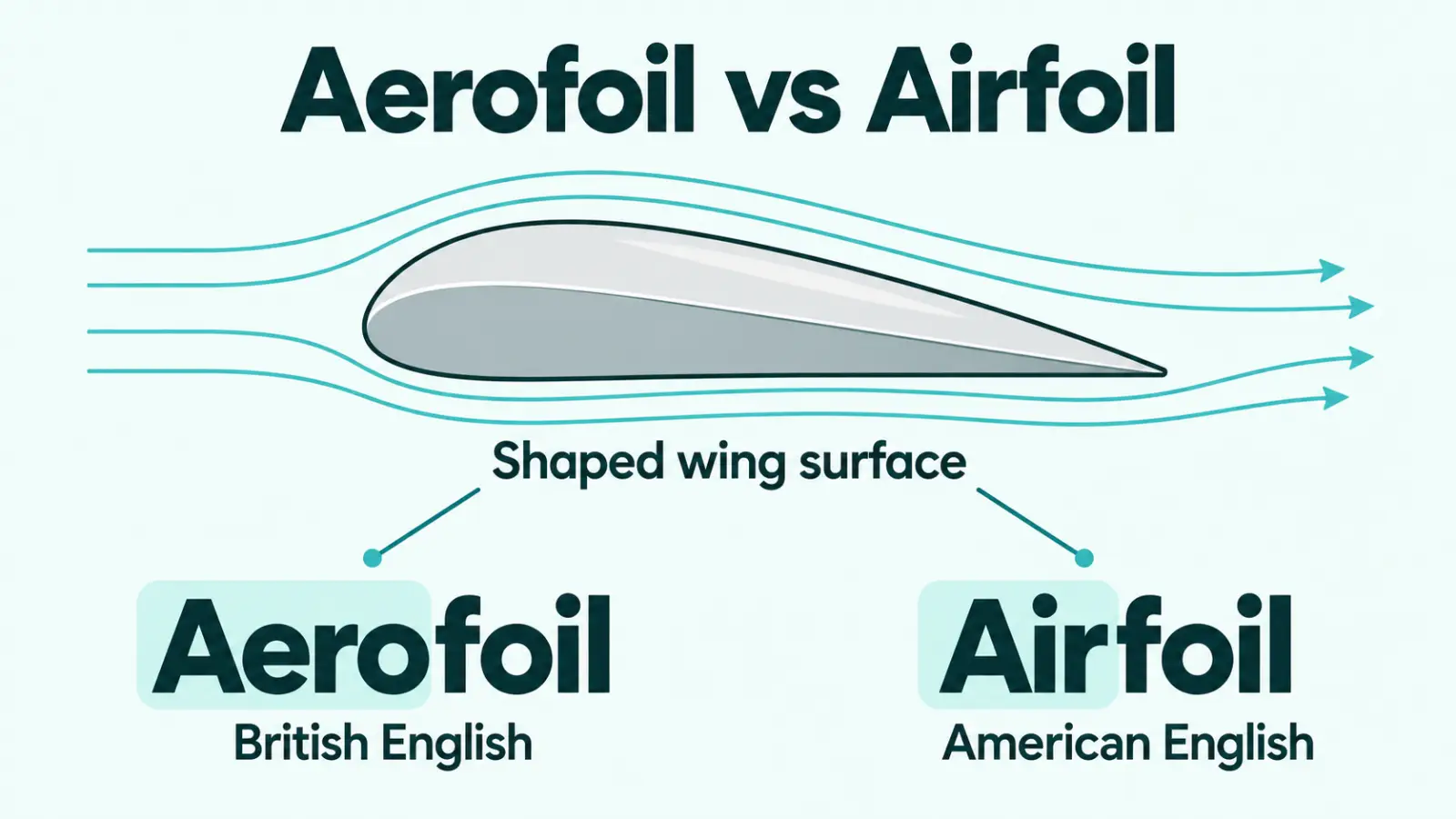
Aerofoil and airfoil are both correct spellings for a specially shaped surface that interacts with moving air to produce aerodynamic forces, including lift. The difference is primarily regional: airfoil is the usual American English spelling, while aerofoil is the usual British English spelling. For writing aimed at US readers, choose airfoil unless you are following a different publication or technical style.
Aerofoil vs Airfoil: Quick Comparison
| Feature | Airfoil | Aerofoil |
|---|---|---|
| Spelling status | ✅ Correct | ✅ Correct |
| Regional association | American English | British English |
| Part of speech | Noun | Noun |
| Meaning | Aerodynamically shaped surface | Same meaning |
| Plural | Airfoils | Aerofoils |
| Example | Airfoil design | Aerofoil design |
| Recommendation for US writing | Preferred | Use when context calls for British spelling |
Neither spelling is a grammatical error. Both describe the same aerodynamic concept.
American English: The engineers tested a new airfoil design.
British English: The engineers tested a new aerofoil design.
The spelling changes, but the engineering meaning does not.
What Is an Airfoil or Aerofoil?
An airfoil is a shape designed to interact with airflow and generate aerodynamic forces. The term often refers to the cross-sectional shape of an aircraft wing, propeller blade, or similar component.
For example, an aircraft wing may have an airfoil-shaped cross section that helps it generate lift as air moves around it.
An airfoil’s performance depends on factors such as its shape, angle relative to the airflow, and operating conditions.
Examples:
- The engineer examined the airfoil’s curved upper surface.
- Students compared two airfoil shapes in a wind-tunnel experiment.
- The propeller uses specially designed airfoil sections.
- Researchers measured how airflow changed around the airfoil.
📌 Important distinction: An airfoil is not necessarily an entire airplane wing. The term often describes the wing’s cross-sectional profile. A complete wing also has features such as span, sweep, and three-dimensional geometry.
Why Does American English Use Airfoil?
The difference reflects two established forms of the same technical term.
Airfoil uses the familiar English word air, while aerofoil uses aero-, a combining form associated with air and aviation.
Both spellings combine an air-related element with foil.
In contemporary usage, the spelling choice generally follows the variety of English being used rather than a difference in the object being described.
American English Examples
- The laboratory developed a new airfoil profile.
- An airfoil can produce lift when moving through air at a suitable angle.
- The instructor explained how pressure varies around an airfoil.
British English Examples
- The team evaluated the aerofoil in a wind tunnel.
- A new aerofoil section was selected for the wing.
- The researchers investigated airflow separation over the aerofoil.
All six sentences are grammatically acceptable. The difference is the regional spelling convention.
How to Choose the Right Spelling
The most reliable test is to identify the intended audience and the spelling convention of the document.
Writing for an American audience?
Use airfoil. It is the standard US form used in NASA’s technical explanations.
Writing for a British audience?
Use aerofoil. It is the British form, described as chiefly British.
Following an existing technical document?
Use the spelling required by its house style. If no rule is specified, choose one form appropriate to your audience and use it consistently.
Example: Editing a Technical Report
Suppose an American engineering team is preparing this sentence:
“The aerofoil profile was evaluated under several airflow conditions.”
The sentence is already grammatically correct. However, an editor following US spelling conventions might write:
“The airfoil profile was evaluated under several airflow conditions.”
Why? The change aligns the spelling with American English. It does not correct a factual error or change the technical meaning.
The reverse would be appropriate for a British publication using British terminology.
Does the Spelling Change the Engineering Meaning?
No. Aerofoil and airfoil refer to the same general aerodynamic concept. Neither spelling indicates a particular wing shape, aircraft type, or aerodynamic performance.
There is, however, an important technical distinction between an airfoil and a wing.
An airfoil commonly refers to a two-dimensional cross-sectional profile. A wing is a three-dimensional structure whose overall shape and dimensions also affect aerodynamic performance.
NASA’s wing-geometry guidance explains this distinction by identifying the airfoil as the cross section of a wing.
NASA
An airfoil also does not have to be strongly curved or flat underneath. Different profiles can be symmetrical or asymmetrical. Their behavior depends on the shape and the conditions of airflow.
For example:
- Airfoil profile: The cross-sectional shape being analyzed.
- Wing design: The larger three-dimensional structure that incorporates airfoil sections.
These distinctions matter more in technical writing than the regional spelling choice.
Common Mistakes to Avoid
Mistake 1: Calling Aerofoil Incorrect
❌ Misleading: Aerofoil is a misspelling of airfoil.
✅ Accurate: Aerofoil is an accepted British English spelling of airfoil.
Explanation: Both forms are recognized. The difference is regional rather than grammatical.
Mistake 2: Mixing Spellings in One Report
⚠️ Inconsistent: The airfoil was tested in a wind tunnel. The aerofoil showed improved performance.
✅ Consistent US English: The airfoil was tested in a wind tunnel. The airfoil showed improved performance.
Explanation: Consistency helps readers understand that the same component or concept is being discussed.
Mistake 3: Assuming Every Airfoil Has a Flat Bottom
❌ Inaccurate: An airfoil must have a curved top and flat bottom.
✅ Accurate: Airfoils can have different cross-sectional shapes, including symmetrical profiles.
Explanation: NASA describes symmetrical airfoils whose upper and lower surfaces mirror one another.
NASA
Quick Practice: Airfoil or Aerofoil?
Choose the spelling that best matches each writing situation.
Question 1: You are writing an American engineering textbook.
“The aircraft uses a newly designed _____.”
A. Airfoil B. Aerofoil
Question 2: You are editing a British aviation magazine that follows British spelling conventions.
“The researchers tested several _____ in a wind tunnel.”
A. Airfoils B. Aerofoils
Question 3: An American report uses airfoil throughout, but one paragraph uses aerofoil. What is the best editorial action?
A. Change aerofoil to airfoil for consistency. B. Keep both because they describe different aerodynamic structures.
Answers and Explanations
| Question | Answer | Explanation |
|---|---|---|
| 1 | ✅ A. Airfoil | It matches standard American spelling. |
| 2 | ✅ B. Aerofoils | It matches British spelling conventions. |
| 3 | ✅ A | The terms have the same meaning, so consistent spelling is appropriate. |
Aerofoil is the spelling associated with British English. It means the same thing as the American English term airfoil. Both forms are recognized in authoritative dictionaries.
Yes. Airfoil is the standard American English spelling and appears in technical materials published by NASA.
Not exactly. Cambridge Dictionary gives airfoil two syllables, approximately “AIR-foil,” while aerofoil has three syllables, approximately “AIR-oh-foil.” Pronunciation also varies by accent.
The regular plurals are airfoils in American English and aerofoils in British English.Examples:US: The engineers compared three airfoils.UK: The engineers compared three aerofoils.
Sources
- Cambridge Dictionary — Airfoil — American English spelling, definition, and pronunciation.
- Cambridge Dictionary — Aerofoil — British English spelling, definition, and pronunciation.

Emily Carter is the writer behind ChuckleStation.com, a site that untangles grammar mistakes, tricky word choices, and common spelling slipups. She focuses on the errors people actually make in emails, essays, captions, and texts, then explains why they happen in plain English.
Every article pairs a clear rule with real sentences, so readers can spot the mistake and fix it fast. Emily double checks each explanation against trusted dictionaries and style guides, because getting a grammar answer wrong defeats the whole point.
She believes good writing shouldn’t feel intimidating. A little humor, a few memorable examples, and a straight answer usually do more than a page of rules.